- By Tanuja
- September 5, 2026
- No Comments
Indian IT Stocks Under AI Disruption: Risks & Opportunities
Indian IT Stocks Under AI Disruption: Risk, Opportunity and the Road Ahead
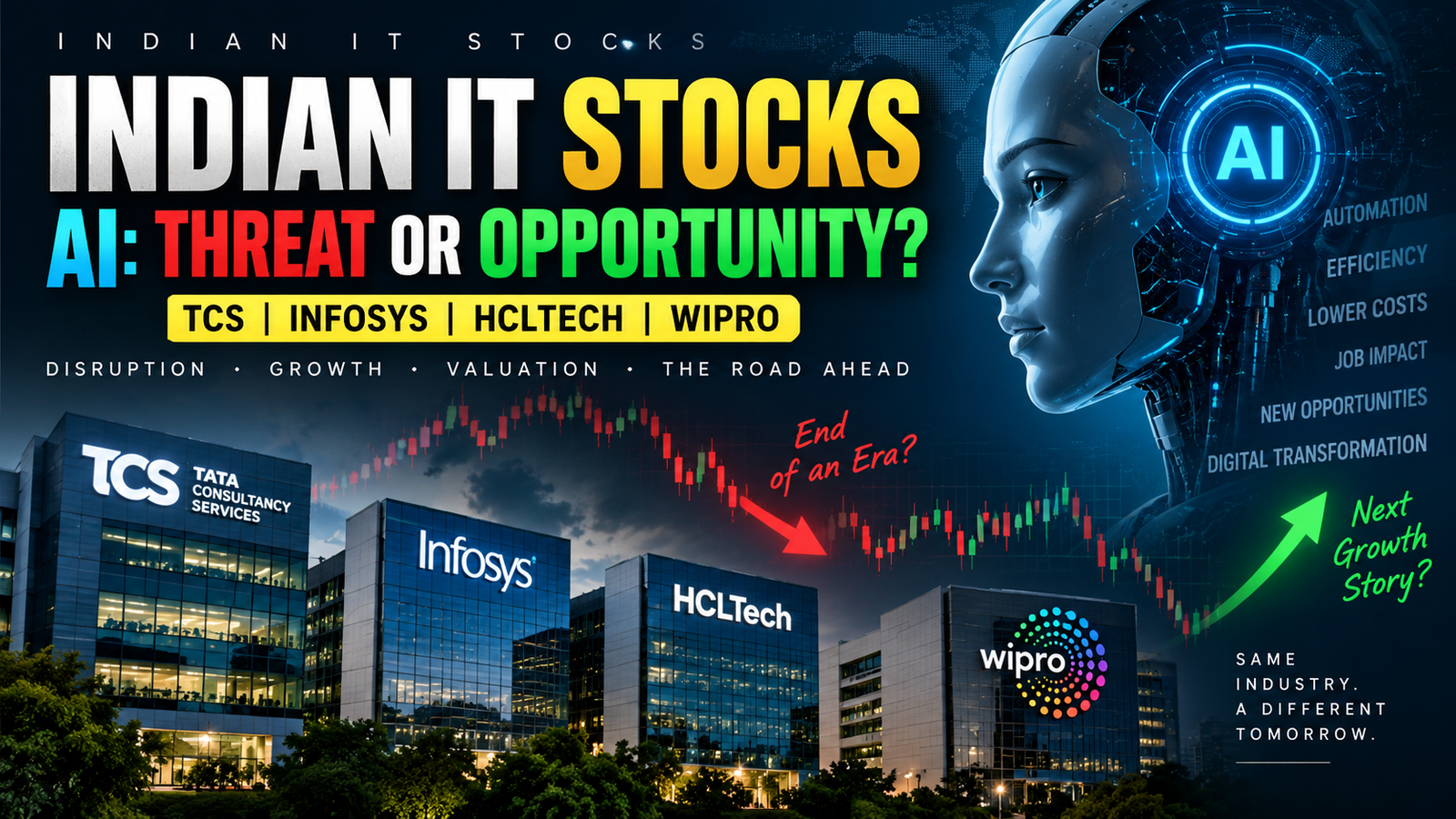
Indian IT stocks are facing one of their biggest structural challenges yet. The rise of Artificial Intelligence (AI), changing client expectations, pressure on IT budgets and the possibility of lower pricing are forcing companies such as TCS, Infosys, HCLTech and Wipro to rethink their traditional business models.
The Nifty IT Index has significantly underperformed the broader Nifty 50, highlighting the growing concerns around the sector. The bigger question for investors, however, is not simply whether AI will hurt Indian IT companies.
The real question is:
Will AI shrink the traditional IT services market—or create an even larger opportunity for companies that successfully adapt?
This is where the concept of creative destruction, first-principles thinking and valuation becomes important.
Indian IT Sector vs Nifty 50: Why Is There Such a Difference?
The Indian IT sector has been under significant pressure, with the Nifty IT Index falling substantially from its previous highs while the broader Nifty 50 has remained relatively more resilient.
This divergence suggests that the market is pricing in a structural change in the IT industry rather than simply a temporary slowdown.
The concerns are largely centred around AI.
For years, Indian IT companies built their businesses around solving technology and business problems for global clients, particularly in the US. Their competitive advantage came from India’s relatively lower-cost engineering talent and the ability to deliver services at attractive margins.
AI is now challenging that traditional equation.
AI Is Changing Client Expectations
One of the biggest changes brought by AI is the shift in client expectations.
Earlier, a client might have a particular business or technology problem and allocate a specific budget to an IT services company to solve it.
Today, clients increasingly expect AI to reduce the amount of human effort required to solve the same problem.
This creates a difficult situation for traditional IT service providers.
The client may still want the same outcome, but may not be willing to pay the same amount for achieving it.
In simple terms:
The problem may remain the same, but the budget available to solve it can shrink because AI itself becomes part of the solution.
This is what creates the possibility of AI deflation in IT services.
What Is AI Deflation in IT Services?
Consider a simplified example.
Suppose a client has a business problem worth $100 million and previously allocated the entire budget to an IT services company.
After the adoption of AI, the client may decide to spend:
- $80 million on the IT services provider
- $20 million internally on AI-related technology and capabilities
The IT company still has to solve the same broad problem, but now it may have a smaller contract value.
This creates pressure on the IT company’s economics.
If revenue declines while the amount of work remains relatively high, the company has to find ways to reduce the effort required.
That could mean:
- Lower employee requirements
- Higher productivity
- Greater utilisation
- Automation
- AI-assisted development
- Changes in pricing
- Restructuring
- New service offerings
The objective is to protect margins despite lower contract values.
The Real Risk: What If AI Shrinks the Total Addressable Market?
This is perhaps the most important question for investors.
Indian IT companies are increasingly arguing that AI will expand the total addressable market (TAM).
The logic is straightforward.
AI will create new technology requirements, cybersecurity needs, data infrastructure requirements and AI implementation opportunities. Therefore, IT companies could potentially capture a larger share of technology spending.
But there is another possibility.
What if AI actually reduces the amount of traditional IT work available?
If AI eliminates certain categories of repetitive or commoditised work faster than new AI-related services are created, the traditional IT services market could shrink.
That would represent a much bigger structural risk.
The survival of Indian IT companies would then depend on their ability to continuously reinvent themselves.
Creative Destruction: The Bigger Economic Picture
The concept of creative destruction helps explain what may be happening inside the IT industry.
Creative destruction essentially describes a process in which new innovation replaces older technologies, processes or business models.
The interesting part is that this transition is often gradual.
Companies build their success on one innovation. Then another innovation emerges. The new technology makes some older processes less relevant, while simultaneously creating new opportunities.
This can happen across entire industries.
The same principle can be applied to Indian IT services.
The industry was built around technology outsourcing, software development, consulting and cost-efficient engineering services.
AI is now becoming the next layer of technological transformation.
The companies that successfully transition into the new ecosystem may survive and grow, while companies that remain dependent on outdated business models could face increasing pressure.
First-Principles Thinking: Understanding the Real IT Business
Another useful framework is first-principles thinking.
Instead of looking at a business through its existing structure, first-principles thinking asks:
What is the fundamental reason this business exists?
For Indian IT companies, the answer is relatively simple.
An Indian IT services company exists because a global client has a business or technology problem that needs to be solved.
If the client has no problem, there is no requirement for the IT service.
Therefore, the fundamental driver of Indian IT services is not simply the number of employees or the amount of software being written.
It is the existence of valuable problems that businesses are willing to pay to solve.
This distinction becomes extremely important in an AI-driven world.
Why the US Market Matters So Much
Indian IT companies have historically generated a significant portion of their revenue from international markets, particularly the United States.
Companies such as Infosys and HCLTech serve clients across sectors including:
- Financial Services
- Manufacturing
- Retail
- Energy
- Telecommunications
- Technology
- Life Sciences
- Public Services
Therefore, the health of global businesses and their technology spending directly influences Indian IT companies.
This creates both an opportunity and a risk.
If US companies continue increasing technology and AI spending, Indian IT companies can potentially capture part of that expenditure.
But if AI significantly reduces the amount businesses need to spend on traditional IT services, the sector could face structural pressure.
India’s Biggest Competitive Advantage: Cost Arbitrage
The traditional Indian IT model has also been supported by labour cost arbitrage.
A technology professional in the US can cost significantly more than an equivalent professional in India.
This allowed global companies to outsource technology work to India while maintaining attractive economics.
However, AI introduces a new variable.
If an AI system can perform work that previously required several engineers, then the traditional labour-cost advantage becomes less powerful.
The competitive question changes from:
“Where can I hire engineers more cheaply?”
to:
“How efficiently can I use technology and AI to solve this problem?”
That is a major change in the industry structure.
HCLTech’s Three-Part AI Framework
The transcript highlights an interesting framework used to think about AI-related opportunities.
The IT business can broadly be divided into three categories:
1. AI-Native Services
These are businesses and services that directly exist because of AI.
Examples include:
- Large Language Models
- Small Language Models
- AI infrastructure
- AI platforms
- AI model development
- Data-centre-related requirements
This segment could experience strong growth if AI adoption accelerates.
2. AI-Amplified Services
These are existing IT services where AI increases productivity or creates additional demand.
Cybersecurity is one example.
As AI adoption increases, companies may need stronger cybersecurity capabilities, creating additional opportunities for IT service providers.
3. AI-Disrupted Services
These are areas where AI can automate or commoditise existing work.
Examples can include:
- Routine accounting
- Bookkeeping
- Certain internal audit activities
- Repetitive software development
- Other highly standardised processes
These segments could face pricing and employment pressure.
How Are Major IT Companies Responding?
The interesting part is that India’s major IT companies are not following exactly the same strategy.
Their approaches appear to be different.
TCS
TCS is focusing heavily on AI adoption and infrastructure while exploring partnerships and capabilities around AI.
The broader strategy is to integrate AI into its existing workforce and service ecosystem.
The idea is that humans and AI agents could increasingly work together.
This could potentially transform the traditional employee-based delivery model.
Infosys
Infosys is positioning AI as an important part of its future service offering.
Its broader strategy focuses on helping clients integrate AI while maintaining control over data, models and technology choices.
At the same time, Infosys has indicated that it is evaluating opportunities around AI infrastructure but has been relatively more cautious regarding direct data-centre investment.
The key strategic question is therefore whether this relatively asset-light approach will prove advantageous over the long term.
HCLTech
HCLTech appears to be taking a broader approach toward the AI ecosystem, including AI infrastructure, end-to-end AI services and smaller language models designed for specific industry requirements.
Its strategy is not limited to traditional IT services.
Instead, it is attempting to participate across different layers of the AI value chain.
Wipro
Wipro’s strategy is more focused around areas such as GCC-as-a-Service and AI-enabled services.
The idea is to help global companies leverage India’s technology ecosystem and cost advantages while using AI to improve productivity.
This could become particularly relevant as multinational corporations expand their global capability centres.
But Management Optimism Is Not Certainty
This is an important point for investors.
When management teams discuss AI opportunities, investors should not automatically treat those statements as guaranteed outcomes.
Different companies are making different strategic bets.
One company may prioritise AI infrastructure.
Another may focus on AI-enabled services.
Another may concentrate on GCCs.
Another may focus on cybersecurity.
The market will eventually determine which strategy creates sustainable economic value.
Therefore, investors need to distinguish between:
Management’s narrative
and
actual financial outcomes.
AI and the Future of IT Employment
One of the most important consequences of AI could be its impact on the traditional employee-based delivery model.
If AI agents become capable of handling a meaningful portion of routine technology work, the relationship between revenue and employee headcount could change dramatically.
Instead of thousands of employees performing repetitive tasks, companies could increasingly operate with:
Human employees + AI agents + automation
This does not necessarily mean that IT companies will suddenly eliminate large numbers of employees.
Instead, the nature of work may gradually change.
Employees could increasingly move toward:
- AI supervision
- Architecture
- Consulting
- Problem solving
- Strategic technology implementation
- Complex engineering
- Client management
- AI governance
The transition, however, may create significant disruption along the way.
The Valuation Question: Growth, Cash Flow and Risk
For investors, understanding the technology is only half the problem.
The other half is valuation.
A company’s valuation ultimately depends on assumptions regarding:
- Revenue growth
- Profit margins
- Free cash flow
- Capital expenditure
- Risk
- Long-term growth
- Terminal value
AI introduces uncertainty into almost every one of these variables.
Will revenue growth accelerate?
Will pricing decline?
Will employee costs fall?
Will productivity improve?
Will margins expand?
Will AI create new markets?
Will traditional IT services shrink?
Will regulation slow adoption?
These questions directly affect valuation.
Why Terminal Value Matters
Terminal value represents the value of a business beyond the explicit forecast period.
For a long-duration business such as an IT services company, terminal value can have a significant influence on the overall valuation.
Therefore, the question is not merely:
“What will the next quarter look like?”
The bigger question is:
“What will this business look like 10, 15 or 20 years from now?”
If an investor believes that AI will strengthen the long-term competitive position of an IT company, the investor may assign stronger long-term growth assumptions.
If the investor believes AI will permanently destroy a large part of the traditional IT services market, the assumptions could be significantly lower.
That difference can produce dramatically different valuations.
Uncertainty Is Not a Reason to Avoid Valuation
Uncertainty is a permanent part of investing.
You cannot eliminate uncertainty.
You can only make assumptions about it.
There are essentially two ways investors can deal with uncertainty:
- Analyse the risk and incorporate it into the valuation.
- Ignore the risk and assume that nothing meaningful will change.
The second approach can be dangerous.
A better approach is to explicitly identify the risks and build different scenarios.
What Should Investors Track in Indian IT Stocks?
Rather than focusing only on quarterly profit numbers, investors should monitor several structural indicators.
1. Revenue Growth
Is growth accelerating or slowing?
2. Deal Wins and Total Contract Value
Are companies winning enough new business to replace declining traditional work?
3. Pricing
Are clients demanding more services for the same amount of money?
4. Employee Headcount
Is headcount growing faster or slower than revenue?
5. Utilisation
Can companies generate more output from the same workforce?
6. Margins
Are AI-driven productivity gains translating into higher margins?
7. AI Revenue
How much actual revenue is coming from AI-related services rather than simply AI-related announcements?
8. New Service Lines
Are companies successfully building businesses around:
- AI
- Cybersecurity
- Cloud
- Data centres
- GCCs
- AI infrastructure
- AI agents
9. Free Cash Flow
Ultimately, stronger cash generation can support higher valuations.
The Bull Case for Indian IT Stocks
The optimistic scenario is that AI does not destroy the IT industry.
Instead, it expands the overall technology opportunity.
Under this scenario:
- AI spending increases
- New technology problems emerge
- Cybersecurity requirements rise
- AI implementation becomes more complex
- Companies outsource AI transformation
- Indian IT firms capture a portion of this spending
- Productivity improves
- Margins remain healthy
- New service categories compensate for traditional work
In this scenario, today’s weakness in IT stocks could eventually create an attractive long-term opportunity.
The Bear Case for Indian IT Stocks
The negative scenario is more structural.
AI could automate a large amount of traditional IT work.
If the reduction in traditional IT spending is greater than the creation of new AI-related spending, the industry’s total addressable market could shrink.
This could lead to:
- Lower contract values
- Pricing pressure
- Lower employee requirements
- Slower revenue growth
- Margin pressure
- Lower long-term cash flows
- Lower terminal value
In that scenario, simply waiting for the traditional IT cycle to recover may not be enough.
Companies would need to fundamentally transform their business models.
So, Are Indian IT Stocks an Opportunity or a Risk?
The answer depends on your assumptions.
The Indian IT sector is clearly undergoing significant disruption from AI.
But disruption does not automatically mean destruction.
Companies with strong balance sheets, established global relationships, large client bases and the ability to invest in new technologies have the potential to evolve.
The key question is whether they can convert AI from a threat to traditional revenue into a new source of revenue and productivity.
That transition will take time.
And the market may continue to remain uncertain until there is greater clarity around actual revenue growth, pricing, margins and AI-driven productivity.
Final Takeaway
The Indian IT industry is entering a period of creative destruction.
The old model—large teams delivering technology services at a cost advantage—is being challenged by AI.
But the new model could be much larger and more productive.
The winners may not necessarily be the companies that simply adopt AI.
The winners could be the companies that understand where AI creates demand, where it destroys demand and how to reposition their businesses accordingly.
For investors, the most important task is therefore not to blindly follow either the bullish or bearish narrative.
Instead, investors should build their own assumptions around:
Growth + Pricing + Margins + Productivity + AI Revenue + Risk + Terminal Value.
Ultimately, the question is not:
“Will AI affect Indian IT companies?”
It almost certainly will.
The real investment question is:
“Which Indian IT companies can successfully evolve with AI—and will their current valuations adequately reflect that future?”
What is your view on Indian IT stocks in the age of AI?
Do you believe AI will become a major growth opportunity for companies like TCS, Infosys, HCLTech and Wipro—or will it structurally reduce the value of traditional IT services?
Share your views in the comments.
Disclaimer
This article is for educational and informational purposes only and should not be considered investment advice, a recommendation, or a solicitation to buy or sell any security. Investors should conduct their own research and consult a qualified financial professional before making investment decisions.
Website: www.capitalcents.in
Facebook: https://www.facebook.com/centscapital/
Instagram: https://www.instagram.com/capital_cents/
Contact: +91 9122669444