- By Tanuja
- September 5, 2026
- No Comments
India Inc’s Big Leadership Exits in 2026: Why Corporate India Is Entering a New Era of Succession
India Inc’s Big Leadership Exits in 2026: Why Corporate India Is Entering a New Era of Succession
When Titans Step Down, Entire Industries Feel the Tremor
Leadership changes are often treated as a corporate HR event.
But when the person leaving sits at the top of a banking giant, conglomerate, airline or technology platform, the impact can go much deeper.
Strategy changes. Investor sentiment changes. Capital allocation can change. And sometimes, the direction of an entire business can change.
That is why 2026 is emerging as an important year for leadership transitions across Corporate India.
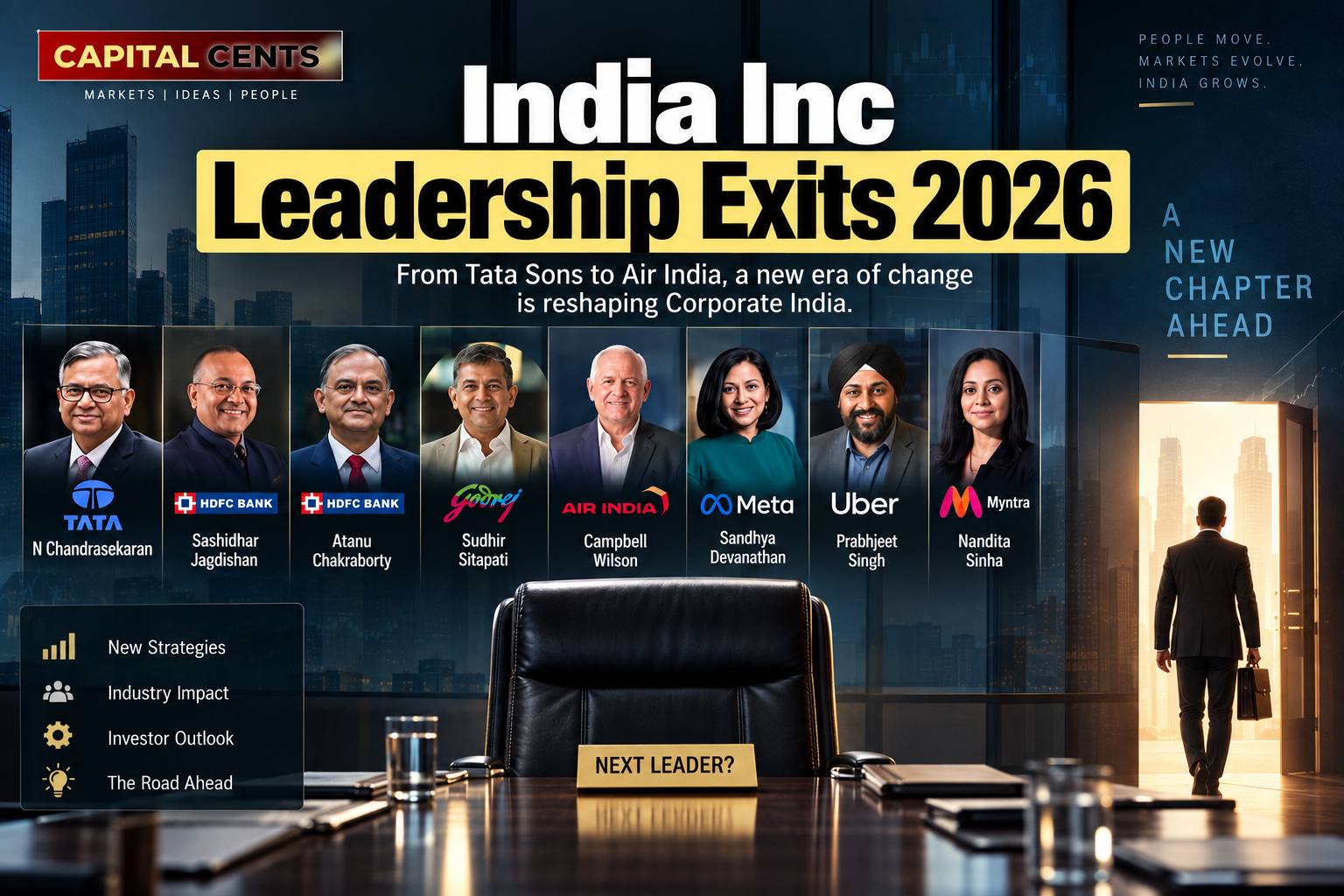
From Tata Sons and HDFC Bank to Godrej Consumer Products, Air India, Meta, Uber and Myntra, several high-profile executives have either announced their exits, completed their transitions or moved into new leadership roles.
The common theme?
Corporate India is moving from the era of individual leadership to the era of institutional succession.
The Big Leadership Transitions of 2026
1. Tata Sons — N Chandrasekaran
Perhaps the most consequential leadership transition is unfolding at Tata Sons.
N Chandrasekaran, who has led Tata Sons since 2017, announced in August 2026 that he would not seek another term when his current tenure ends on February 20, 2027.
His decision came after the proposal to extend his tenure had failed to secure unanimous support earlier in the year. Tata Trusts subsequently initiated the process of setting up a selection committee to identify his successor.
This isn’t simply a change at the top of one company.
Tata Sons is the principal holding company of the Tata Group, making the succession decision strategically important for businesses spanning:
- Technology
- Automotive
- Airlines
- Consumer products
- Steel
- Electronics
- Semiconductors
- Financial services
The next chairman will therefore inherit a group that is simultaneously investing in new-age businesses while managing large established operations.
Why it matters
Chandrasekaran’s successor will need to balance three competing priorities:
Growth + Capital Allocation + Tata’s Governance Philosophy
The biggest question isn’t simply who replaces him?
It is:
Can the next leader maintain Tata’s momentum without disrupting the group’s long-term strategic direction?
The succession process itself has already attracted significant attention because of governance dynamics within Tata Trusts and Tata Sons
HDFC Bank — Sashidhar Jagdishan
The second major transition is playing out at HDFC Bank.
Sashidhar Jagdishan, who became Managing Director and CEO in 2020, has decided not to seek reappointment and is scheduled to step down when his current term ends on October 26, 2026.
This comes at a particularly important time for India’s largest private-sector bank.
HDFC Bank is still dealing with the enormous operational and strategic implications of its 2023 merger with Housing Development Finance Corporation (HDFC Ltd.).
The bank is also navigating regulatory scrutiny, governance questions and investor concerns.
Interestingly, the leadership transition is broader than just the CEO role.
Former chairman Atanu Chakraborty stepped down in March 2026, adding another major change at the top of the institution.
Why it matters
For HDFC Bank, the next CEO will have to answer several critical questions:
- How quickly can post-merger integration be optimised?
- Can growth accelerate without compromising asset quality?
- Can investor confidence be restored?
- How should the bank respond to India’s increasingly digital banking ecosystem?
- Can the next leadership team strengthen governance and regulatory credibility?
The bank’s shares have faced significant pressure during 2026, making the succession process particularly important for investors.
For India’s banking sector, this could be one of the year’s most closely watched CEO transitions.
Godrej Consumer Products — Sudhir Sitapati
Another major leadership shock came from Godrej Consumer Products (GCPL).
Sudhir Sitapati resigned as Managing Director and CEO in August 2026, only around three months after beginning a renewed five-year term.
The market reaction was immediate.
GCPL shares fell more than 11% on August 12, marking the company’s steepest single-day decline in more than six years.
The board subsequently appointed Aasif Malbari, the company’s CFO, as the new MD and CEO.
Why investors reacted strongly
Leadership continuity matters, especially when a company is executing a long-term transformation strategy.
GCPL has been working on its Vision 2040 strategy, while simultaneously focusing on profitability, innovation, digital marketing and online channels.
Therefore, the key question for investors is not simply whether the company can replace Sitapati.
It is whether the strategic roadmap survives the leadership change without losing execution momentum.
Air India — Campbell Wilson
Air India’s leadership transition is different.
Campbell Wilson announced his resignation in April 2026 after leading the airline through one of the most ambitious transformations in Indian aviation.
During his tenure, Air India underwent major changes including airline integrations, fleet modernisation, technology upgrades and service transformation. Air India said the period included the successful merger of four airlines and the addition of around 100 aircraft to the fleet.
But this is where the story becomes particularly interesting.
Air India’s next chapter is already underway.
In August 2026, Air India appointed Tewolde Gebremariam as CEO and Managing Director, succeeding Campbell Wilson. The airline said the new leadership is expected to focus on operational excellence, international expansion, hub development, safety and profitable growth.
From turnaround to scale
This represents a strategic shift.
Campbell Wilson’s phase was largely about:
Stabilisation → Integration → Transformation
The next phase is about:
Scale → Efficiency → Global Competition → Profitability
With Air India preparing for significant fleet expansion and international growth, the leadership transition could have implications far beyond the airline itself.
It could influence India’s ambition to become a global aviation hub.
Meta — Sandhya Devanathan
The technology sector is experiencing a different kind of leadership movement.
Sandhya Devanathan stepped down from Meta after more than a decade with the company.
She had served as Meta’s India and Southeast Asia leader since 2023 before taking on broader regional responsibilities.
In August 2026, it was announced that she would join OpenAI in a newly created regional leadership role covering Southeast Asia and Australia. Her responsibilities include consumer growth, enterprise adoption, partnerships and regulatory engagement.
Why this is significant
This isn’t merely a leadership exit.
It highlights the growing competition for senior technology talent between traditional Big Tech and AI companies.
India and Southeast Asia are becoming increasingly important markets for:
- AI adoption
- Enterprise technology
- Digital advertising
- Consumer platforms
- Regulatory engagement
The movement of experienced executives between companies shows how quickly the technology leadership landscape is changing.
Uber India — Prabhjeet Singh
Prabhjeet Singh stepped down as President of Uber India & South Asia in June 2026 after nearly 11 years with the company.
His departure marks the end of a long leadership chapter for Uber in one of its most important international markets.
India remains strategically important for Uber because of:
- Massive urban mobility demand
- Rapid digital adoption
- Growing EV ecosystem
- Competition from domestic mobility platforms
- Expansion into new mobility categories
The challenge for the next leadership team will be balancing growth, driver economics, profitability and regulatory complexity.
And in an industry where consumer expectations change rapidly, leadership execution can directly influence market share.
Myntra — Nandita Sinha
The Myntra transition is perhaps the most interesting example of leadership mobility within India’s consumer-tech ecosystem.
Nandita Sinha moved on from Myntra after serving as CEO since 2022.
Flipkart appointed Sharon Pais as the new head of Myntra in April 2026, with Pais bringing significant experience from within the Flipkart ecosystem.
But Sinha’s story didn’t end there.
In July, Swiggy appointed her as the CEO of Instamart, effective August 3, 2026.
This is strategically fascinating.
A leader who helped scale a major fashion-commerce platform is now moving into quick commerce, one of India’s most fiercely competitive consumer markets.
The bigger story
This transition shows how India’s consumer internet ecosystem is becoming increasingly interconnected.
Leadership experience in:
E-commerce → Consumer Behaviour → Digital Operations → Quick Commerce
is becoming highly transferable.
And Sinha’s move places her at the centre of Swiggy’s battle with players such as Blinkit and Zepto.
What Do These Leadership Exits Really Tell Us?
Looking at these transitions individually is interesting.
Looking at them together is much more revealing.
1. Succession Planning Is Becoming a Strategic Asset
Earlier, succession was often considered a boardroom formality.
Today, it can influence:
- Stock prices
- Employee confidence
- Investor sentiment
- Strategic investments
- M&A decisions
- Regulatory relationships
- Market positioning
The HDFC Bank and Tata Sons transitions demonstrate how closely investors watch leadership continuity.
2. Institutional Strength Matters More Than Individual Stardom
A strong CEO can accelerate a company.
But a strong institution should be able to survive the departure of that CEO.
That creates an important test:
Was the success created by the leader, or was the leader successful because the organisation had built strong systems around them?
This distinction becomes especially important for companies such as Tata Sons and HDFC Bank.
AI Is Changing the Executive Talent Market
The movement of executives such as Sandhya Devanathan into AI-focused leadership roles highlights another emerging trend.
The competition is no longer just:
Company vs Company
It is increasingly:
Traditional Tech vs AI-native companies for leadership talent.
Experienced executives who understand consumers, enterprises, partnerships and regulation can become extremely valuable as AI adoption accelerates.
Consumer Internet Is Entering Its Next Phase
Myntra, Uber and Instamart represent another important trend.
India’s consumer internet companies are moving beyond the initial phase of:
User acquisition at any cost
towards:
Efficiency + Retention + Monetisation + Profitability
Leadership teams therefore need a different playbook.
The next generation of executives will increasingly be judged not only by how fast they grow a platform, but by how efficiently they can scale it.
Boards Are Being Tested Like Never Before
Leadership transitions ultimately test the quality of a company’s board.
A strong board must be able to:
- Identify successors early
- Communicate clearly with investors
- Protect institutional knowledge
- Maintain strategic continuity
- Manage regulatory expectations
- Prevent leadership uncertainty from becoming business uncertainty
This is particularly important when multiple senior executives depart around the same period.
Which Leadership Transition Could Create the Biggest Strategic Pivot?
If we look purely from a strategic impact perspective, three transitions stand out.
Tata Sons
The Tata Group operates across multiple industries and is simultaneously pursuing major investments in technology, manufacturing, aviation and other new businesses.
The next chairman could influence capital allocation and the strategic direction of one of India’s most important business groups.
HDFC Bank
HDFC Bank’s next CEO inherits the challenge of steering India’s largest private-sector bank through a major post-merger phase while restoring investor confidence and maintaining growth.
The impact could be particularly significant for the Indian banking and financial-services ecosystem.
Air India
Air India’s transition could have implications beyond corporate strategy.
With its massive fleet plans and international ambitions, the airline’s performance could influence India’s broader aviation ecosystem and global connectivity ambitions.
The Bigger Picture: Corporate India Is Entering a Succession Era
The most important takeaway from these exits is not that senior executives are leaving.
Executives will always move.
The bigger story is how companies respond when they do.
A leadership transition can become either:
A crisis
or
An opportunity.
For investors, therefore, the right question isn’t simply:
“Who is leaving?”
It is:
“Who is coming next, what mandate will they receive, and can they execute it?”
That is where the real investment story begins.
Final Takeaway
2026 may ultimately be remembered as a year when Corporate India’s leadership architecture began to change.
From Tata Sons and HDFC Bank to Air India, Godrej Consumer Products, Meta, Uber and Myntra, these transitions demonstrate that the next phase of corporate growth will depend increasingly on institutional resilience, succession planning and the ability to reinvent strategy without losing momentum.
Because when a CEO leaves, the company doesn’t get a reset button.
It gets a stress test.
And the companies that pass that test will be the ones capable of turning leadership uncertainty into their next phase of growth.
People move. Markets evolve. Institutions endure.
Capital Cents View
For investors, leadership changes should not automatically be interpreted as a buy or sell signal.
Instead, watch these five indicators:
1. Who is appointed as successor?
2. Is the strategic roadmap changing?
3. How does the board communicate the transition?
4. What happens to execution and financial performance?
5. Does investor confidence recover after the initial uncertainty?
Ultimately, good succession is not about replacing a person. It is about protecting the future of the business.
This article is for informational and educational purposes only and should not be considered investment advice.
Website: www.capitalcents.in
Facebook: https://www.facebook.com/centscapital/
Instagram: https://www.instagram.com/capital_cents/
Contact: +91 9122669444