- By Rahul
- November 2, 2026
- No Comments
Stock Market Today, 2 November 2026: Nifty 50, Bank Nifty & Stocks to Watch
Stock Market Today, 2 November 2026: Nifty 50, Bank Nifty Analysis and Stocks to Watch
Published: 2 November 2026
By: Capital Cents Research Desk
Category: Stock Market News | Pre-Market Analysis | Technical Analysis
The Indian stock market enters Monday, 2 November 2026, with investors watching whether the recent rally in the Nifty 50 can continue or whether consolidation and profit booking will emerge. The previous trading session, Friday, 30 October, saw the Nifty 50 rise above the psychological 23,000 mark, while the Bank Nifty closed lower.
For today’s trading session, market participants should monitor key support and resistance levels, index momentum, derivatives positioning, global market cues and company-specific developments.
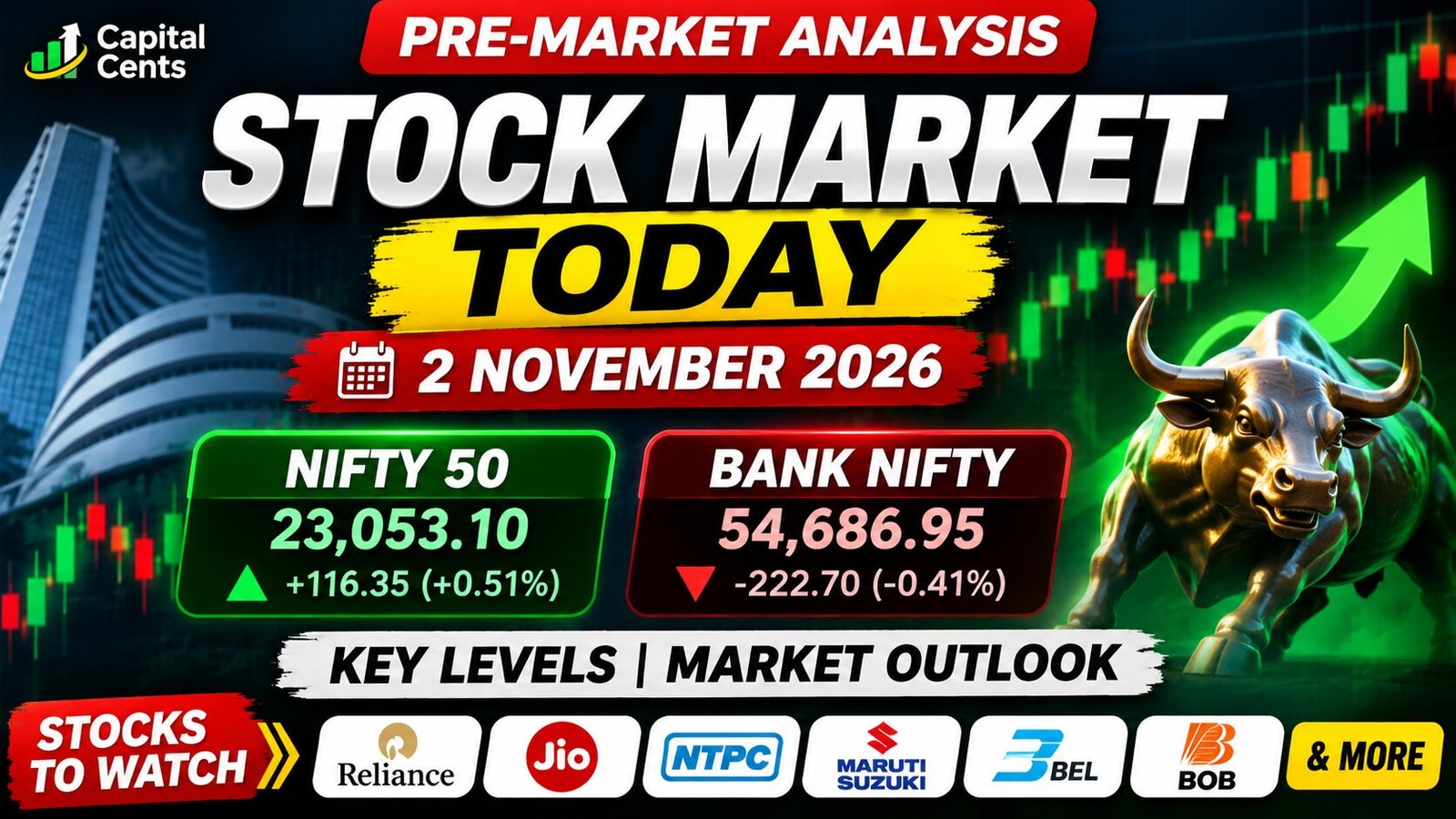
Several stocks are also in focus, including Reliance Industries, Jio Platforms, NTPC, Maruti Suzuki, Bharat Electronics and Bank of Baroda. Quarterly earnings and monthly automobile sales updates are among the important stock-specific developments to track.
This Capital Cents pre-market report covers the Nifty 50 outlook, Bank Nifty technical levels, stocks to watch, market risks and important trading considerations for Monday.
1. Indian Stock Market Overview
According to Moneycontrol’s November 2 trade setup, the Nifty 50 closed at 23,053.10 on October 30, gaining 116.35 points, or approximately 0.51%. The Sensex ended at 74,459.53, up 308.49 points, or 0.42%.
The Bank Nifty, however, declined 222.70 points, or 0.41%, to close at 54,686.95.
These figures show that the broader market indices did not move uniformly. While the Nifty 50 and Sensex advanced, banking stocks experienced some weakness.
Traders should therefore avoid assuming that strength in one index automatically confirms strength across the entire market.
2. Nifty 50 Analysis Today: Important Support and Resistance Levels
The Nifty 50 continued its positive momentum on October 30, closing above 23,000. Its short-term technical structure remained constructive, supported by upward-sloping short-term moving averages and improving momentum indicators.
However, a positive technical structure does not guarantee that the market will rise in every session.
Nifty 50 support levels
The important support zone highlighted in the November 2 trade setup is 22,800–22,900.
The pivot-based support levels are:
- 22,944
- 22,894
- 22,812
The 22,800–22,900 region is particularly important because sustained trading above this zone could help preserve the positive short-term outlook.
If the index falls below this area and fails to recover, traders should reassess the bullish scenario and watch for additional weakness.
Nifty 50 resistance levels
The pivot-based resistance levels are:
- 23,107
- 23,157
- 23,238
Beyond these immediate levels, 23,200 is an important upside reference, followed by the 23,500–23,600 resistance zone.
The index’s ability to sustain above resistance, supported by price action and trading volume, will be more meaningful than a brief intraday move above a particular level.
What does the Nifty 50 chart indicate?
The Nifty 50 formed a bullish candle on October 30 following a strong upward session. Its RSI stood at 53.5, while the MACD remained above its reference line.
These indicators suggest improving momentum, although traders should combine them with price structure, volume and market breadth rather than relying on a single indicator.
Trading perspective: The short-term bias remains constructive while the key support zone holds, but resistance levels and intraday confirmation should guide trading decisions.
3. Bank Nifty Analysis Today
The Bank Nifty ended October 30 at 54,686.95, declining 0.41%. Unlike the Nifty 50, the banking index showed signs of weakness following its recent rally.
The index continued to trade below its key moving averages and faced resistance around its 20-day exponential moving average. Its RSI stood at 44.97, indicating a comparatively weaker momentum picture.
At the same time, the MACD registered a positive crossover, suggesting the possibility of a recovery attempt. These mixed signals make confirmation particularly important.
Bank Nifty support levels
The pivot-based support levels for November 2 are:
- 54,592
- 54,477
- 54,291
Additional support references from Fibonacci analysis include 54,035 and 52,784.
Bank Nifty resistance levels
The important pivot-based resistance levels are:
- 54,965
- 55,080
- 55,266
Fibonacci resistance references include 55,128 and 55,538.
The 55,000 area is also important in the options market, where substantial call open interest was reported. This may act as a resistance reference, although options positioning can change during the session.
What should traders watch?
A sustained recovery above resistance, supported by improving price action, could indicate a stronger recovery attempt. Failure to hold support may signal renewed weakness.
Traders should avoid treating individual levels as guaranteed reversal points. Confirmation and predefined risk limits remain essential.
4. Stocks to Watch Today: 2 November 2026
Several companies are in focus because of quarterly earnings, business updates and other company-specific developments.
Reliance Industries
Reliance Industries reported year-on-year growth in its second-quarter consolidated results, according to Moneycontrol’s November 2 stocks-to-watch report.
Profit increased 33.8% to ₹29,550 crore, while revenue rose 27.8% to ₹3.62 lakh crore. EBITDA increased 23.9% to ₹62,409 crore, although the EBITDA margin declined to 17.2% from 17.8%.
Market participants should assess the results alongside price action and the market’s response to the reported numbers.
Jio Platforms
Jio Platforms reported a 13.7% year-on-year increase in profit to ₹8,387 crore. Revenue increased 11.3% to ₹47,485 crore, while EBITDA margin expanded to 54.1%.
The reported figures provide context for monitoring developments associated with the broader Reliance group.
NTPC
NTPC reported a 14.3% year-on-year increase in standalone profit to ₹5,319.9 crore. Revenue increased 16.8% to ₹45,752 crore.
Traders should track the stock’s reaction to these results rather than assuming that positive earnings automatically lead to an immediate price increase.
Bharat Electronics
Bharat Electronics reported year-on-year growth in consolidated profit and revenue. Profit increased 19.7% to ₹1,540.4 crore, while revenue rose 26.5% to ₹7,327.7 crore.
The stock remains one of the companies to monitor for its market response to the reported results.
Maruti Suzuki and automobile stocks
Maruti Suzuki reported total October sales of 2.67 lakh units, representing year-on-year growth of 20.9%. Domestic sales increased 19.3%, while exports rose 59.3%.
Other automobile companies in focus include Tata Motors, Mahindra & Mahindra, Hyundai Motor, Eicher Motors and TVS Motor.
Monthly sales numbers can influence expectations for revenue growth, but investors should also consider product mix, margins, demand trends and other business factors.
Bank of Baroda
Bank of Baroda reported a 35.8% year-on-year increase in standalone profit to ₹6,531.5 crore. Net interest income rose 9% to ₹13,026.3 crore.
The stock’s market reaction, along with the broader Bank Nifty trend, will be important to monitor.
Additional stocks in focus
Other companies appearing in Moneycontrol’s November 2 watchlist include:
- Affle 3i
- KIMS
- NCC
- Jio Platforms
- Coal India
- Granules India
- RBM Infracon
- EAAA India
Investors should verify the specific announcement or catalyst for each company before drawing conclusions about its potential price movement.
5. Global Market Cues and Key Factors
Global market sentiment can influence domestic equities through changes in risk appetite, currency movements, commodity prices and foreign investor flows.
The market setup also requires attention to crude oil prices and global equity performance. Elevated oil prices can affect inflation expectations and costs for oil-importing economies such as India.
Investors should monitor the latest available information on:
- US and Asian equity markets
- Crude oil prices
- The USD/INR exchange rate
- Foreign institutional investor and domestic institutional investor activity
- India VIX and changes in market volatility
- Corporate earnings and economic announcements
Global market data can change quickly. Traders should verify current figures before the market opens rather than relying on stale overnight snapshots.
6. FII and DII Activity: Why It Matters
Foreign institutional investors (FIIs) and domestic institutional investors (DIIs) are important participants in Indian equity markets.
Their cash-market buying and selling activity can provide context about institutional flows, but a single session’s data does not determine the market’s direction.
Investors should evaluate these flows alongside index performance, derivatives positioning, sector participation and broader market breadth.
Institutional activity should be treated as one input in a larger analytical framework, not as an independent buy or sell signal.
7. Trading Strategy for Monday
A structured trading plan can help traders avoid impulsive decisions during volatile market conditions.
Step 1: Identify the market structure. Review the previous session’s high, low, closing level and important support and resistance zones.
Step 2: Wait for confirmation. Observe whether the index sustains above resistance or loses support. A brief move through a level is not necessarily a confirmed breakout.
Step 3: Monitor volume and market breadth. Check whether the move is supported by participation across stocks and sectors.
Step 4: Define risk before entry. Establish an invalidation level and stop-loss before placing a trade. Position size should reflect the amount of risk being taken.
Step 5: Avoid overtrading. If price action is unclear or the market is moving sideways, waiting may be preferable to forcing a trade.
Step 6: Review the outcome. Record the setup, entry rationale, exit and any deviations from the trading plan in a trading journal.
These steps are educational principles for disciplined decision-making, not specific instructions to buy or sell a security.
8. Important Risks for Today’s Session
Several factors could affect the market outlook:
- Resistance near key levels: The Nifty 50 may encounter selling pressure around technical resistance.
- Banking-sector weakness: The Bank Nifty’s comparatively weaker structure could affect broader market sentiment.
- Global volatility: International equities, crude oil and currency movements may influence domestic trading.
- Earnings-related volatility: Stocks can react unpredictably to quarterly results, even when reported numbers appear positive.
- False breakouts: Intraday moves above resistance or below support may reverse.
- Derivatives risk: Leverage, time decay and sudden volatility can amplify losses, particularly in options trading.
No technical level or market indicator can eliminate trading risk.
9. Frequently Asked Questions
What is the Nifty 50 outlook for 2 November 2026?
The short-term outlook remains constructive while the 22,800–22,900 support zone holds. The index’s response to immediate resistance around 23,107–23,238 will be important.
What are the key Nifty 50 support levels?
The key pivot-based support levels are 22,944, 22,894 and 22,812. The broader support zone highlighted in the trade setup is 22,800–22,900.
What are the important Bank Nifty levels?
The pivot-based support levels are 54,592, 54,477 and 54,291. Resistance levels are 54,965, 55,080 and 55,266.
Which stocks are in focus today?
Reliance Industries, Jio Platforms, NTPC, Bharat Electronics, Maruti Suzuki and Bank of Baroda are among the stocks to watch, along with Affle 3i, KIMS, NCC, Coal India, Granules India and RBM Infracon.
Does a bullish Nifty outlook guarantee a positive trading session?
No. Technical indicators describe potential scenarios, not guaranteed outcomes. Unexpected news, global volatility and selling pressure can change the market direction.
How can beginners use pre-market analysis?
Beginners can use pre-market analysis to understand the market context, identify important levels, prepare a watchlist and establish risk limits. They should avoid entering trades solely because a report mentions a stock or index level.
Conclusion
The Indian stock market begins 2 November 2026 with the Nifty 50 above 23,000 and the Bank Nifty showing a comparatively weaker trend. The Nifty’s 22,800–22,900 support zone and resistance around 23,200 and 23,500–23,600 are important reference points for the session.
Reliance Industries, Jio Platforms, NTPC, Bharat Electronics, Maruti Suzuki and Bank of Baroda are among the companies attracting attention because of their reported results or business updates.
For traders, the priority should be to combine technical analysis with current market information, wait for price confirmation and maintain disciplined risk management.
Follow Capital Cents for daily pre-market analysis, post-market reports, stock market education and technical analysis.
Disclaimer: This article is for educational and informational purposes only. It is not investment advice or a recommendation to buy, sell or hold any security or derivative. Market levels and company information may change. Verify current data and consult a qualified financial professional where appropriate.
Source references: Moneycontrol’s November 2, 2026 trade setup and stocks-to-watch reports. This article summarizes the cited reporting and provides educational commentary; it is not an independent verification of company disclosures.